


How the world of First Aid has changed
- Jul 16
- 3 min read
I remember my very first course in First Aid like it was yesterday. I did it when I was very young (back when dinosaurs still roamed the earth!)
It was with St. Johns Ambulance Corps. I was training to become a Cadet.
The course took five days!
It was tough. Very tough. And so were the instructors.
They drilled you and schooled you, like every single thing you were learning was a matter of life and death. Which of course it was.
They even measured the wrapping of the bandage you put on a limb with a ruler. If the overlapping of the bandage was not perfectly uniform ..... aagh! ... You got another zap from the cattle prod! (Well that’s what it felt like when the instructor glared at you!)
Now I’m using a little poetic license to make the point that the instructors were ruthless.
They made sure that when you graduated from the course, that you were absolutely certain of your own competence... because you were too scared to be incompetent!
Why?
You have imagine a scenario from the 1960s or 1970’s. And what it was like if you need to apply first aid to help someone.
For example imagine you come across a car accident, out on the fringes of suburbia. The driver is badly injured. You to help them. AND you need an ambulance fast.
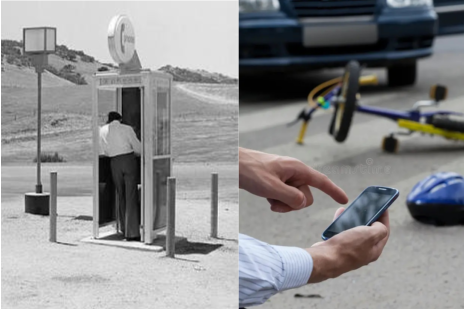
What did you do back then? Well first, someone had to find a phone booth to call an ambulance. It could be miles away.
Or you had to look for a house that had a phone line connected to it or even a shop or business. (For Millennials and Gen Y: if you Google “Phone Booth”, you’ll discover it’s an ancient archaeological structure!)
So you can understand how long back then it actually took for the ambulance to arrive, after you spent ages trying to find out how to call them.
It meant that from a First Aid point of view you absolutely had better know what you are doing.
This why those early First Aid Courses took many days to complete and were conducted with the utmost seriousness.
Today the world of First Aid has changed dramatically.
Now you have that phone booth in your pocket. And you use it to do a lot more than just make calls.
What a miracle it is!
An ambulance today responds very quickly to serious events particularly in urban areas. There are simply more of them than there were back in the 1960s. You can call one instantly. It will most likely arrive very fast.
The 000 operators are very well trained and can talk you through how to handle almost any type of accident, incident or injury.
If you have to use an AED (or defib/defibrillator) on someone who goes into cardiac arrest, these days even these are automatic and talk you through exactly what to do and when.
Bottom line is, we are all much better prepared to handle any emergency today than we ever were at any point in our history.
However it still vitally important to learn first aid. Thankfully the courses don’t go for 5 days any more. More like 5 hours. The reality is you can learn all the vital basics of first aid, including CPR, in that time.
You’ll then be trained in how to handle all the most common emergencies with First Aid.
Now of course, even doctors and nurses sometimes get rattled in an emergency. While some peple remain as cool as the other side of the pillow in an emergency.
So even we as first aid trainers understand that there’s never a calendar entry warning you that “Grandpa” will be having a stroke next Tuesday at 9:00pm.
If someone you love is suddenly badly injured or ill, you can forget everything you know – all the knowledge you learned in your course can just fly out of your head.
In this case, just pull out that phone booth you have in your pocket! (Mobile phone).
And a calm educated voice will get you through it.
In the next blog, I’ll cover some amazing apps for your mobile phone and what to do when you are worried and you’re not sure whether you should call 000 or not.
Cheers
Rory Barnes
Co-founder Results First Aid


Comments